Printing on Hi-Vis: Where Your Logo Can Go and What to Check Before You Order
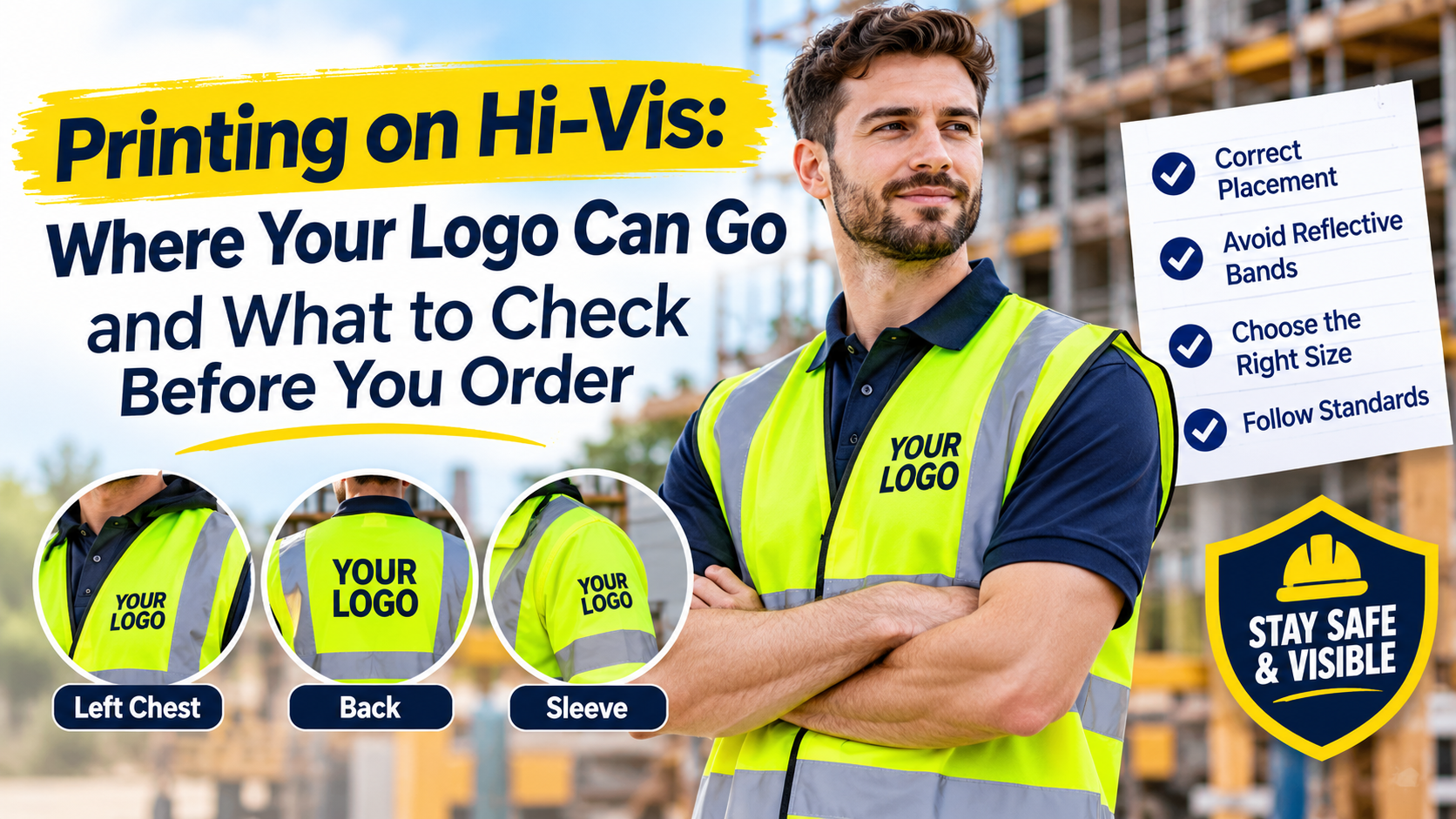
Yes, you can put your company logo on hi vis Printing clothing, and most businesses do. The rule that matters is simple: the logo must sit on the fluorescent fabric, never over the reflective bands, and it shouldn’t cover so much of the garment that it stops doing its job. Get that right and you have a vest or jacket that looks professional and still keeps your team visible.
Where people go wrong is in the details: a back print that’s too big, a logo that crosses a silver stripe, or a garment bought without checking what the site actually requires. This guide walks through where logos can go, what to avoid, and the checks worth making before you order.
Why Hi-Vis Isn’t Like Other Workwear
A polo shirt is just a polo shirt. A hi-vis vest is safety clothing, and the way it’s built has a purpose.
Two materials do the work:
- Fluorescent background fabric, usually yellow or orange, which makes the wearer stand out in daylight.
- Retroreflective bands, the silver strips that bounce light back towards a vehicle’s headlights in the dark.
Anything you add to the garment, whether print, embroidery or patches, either respects those two materials or interferes with them. That’s why logo placement on hi-vis deserves more thought than it would on a hoodie.
What About the Standard?
In the UK, high-visibility clothing is commonly made to EN ISO 20471, which groups garments into classes (1, 2 and 3) depending on how much fluorescent and reflective material they contain. Higher classes carry more visible material and suit higher-risk environments such as roadsides.
Branding comes into this in one way. Adding a logo covers part of the fluorescent fabric, and printing or stitching over a reflective band can damage how well it reflects. The garment’s manufacturer sets how much logo space is acceptable, and some publish a maximum logo area for each product.
A few honest points before we go further:
- Standards and site rules change and vary, so please treat this as general guidance, not a compliance ruling.
- Confirm what your site actually requires with your site manager, principal contractor or health and safety adviser. Some sites and sectors specify a minimum class or have their own rules, and rail, highways and airside work often have extra requirements.
- If a garment is certified, the certification belongs to the garment as made. If you’re unsure whether your branding affects it, ask the manufacturer or supplier before you order a full batch.
Where Can Your Logo Go?
On a standard hi-vis vest, the usual layout has reflective bands running around the body and over the shoulders. The spaces between them are where branding lives.
|
Position |
Typical use |
Notes |
|
Left chest |
Small company logo |
The classic spot. Keep it small and clear of any vertical bands |
|
Centre back |
Company name or larger logo |
The most visible branding area, but also where size matters most |
|
Back, between bands |
Name, trade or slogan |
Check the gap is large enough for the design |
|
Sleeve |
Small secondary mark (on jackets and sleeved garments) |
Only where there’s clean fluorescent fabric |
|
Lower front |
Rarely used |
Usually crowded by bands and fastenings |
Chest
A left-chest logo is the neat, professional choice. Because the front of a vest has less free fabric than the back, keep the design compact. A short wordmark or a simple symbol reads far better than a detailed crest.
Back
The back is where most of your brand visibility comes from, and it’s also where it’s easiest to overdo things. A large solid logo can cover a lot of fluorescent fabric, so size it sensibly and stay within the space between the bands. If the manufacturer gives a maximum logo area for your garment, treat it as a firm limit.
Sleeves and jackets
Hi-vis jackets give you a bit more room, including sleeves, but they also have more bands to work around. If your jacket is waterproof or made from coated fabric, tell us. Not every method works on every surface, and we’d rather talk it through than guess.
You can see the options on our hi-vis vest and jacket printing page, and our wider personalised hi-vis clothing page covers the full range.
What to Avoid
These are the mistakes we’d steer you away from.
Printing or stitching over reflective tape. This is the big one. A logo that crosses a silver band can reduce how well the tape reflects, which defeats the point of wearing it. Keep your artwork on fluorescent fabric only.
Oversized logos. A huge dark block on the back removes visible fluorescent fabric. Bigger isn’t better here.
Low-contrast colours. White, pale yellow or neon ink disappears against a fluorescent background. Dark colours such as black or navy stay readable from a distance.
Fine detail. Thin lines, tiny taglines and intricate illustrations blur at a distance and on textured fabric. Hi-vis logos work best bold and simple.
Ordering before checking the rules. A batch of vests that doesn’t meet a site’s requirements is an expensive lesson.
Choosing Your Logo Colour and Size
Because hi-vis is worn at a distance and often outdoors, think about readability rather than style.
- Stick to one or two colours. Black on fluorescent yellow or orange is the clearest combination.
- Use bold lettering. A company name in thick capitals reads far better than a script font.
- Simplify your logo. If yours is detailed, a “uniform version” without the tagline works much better.
- Add job titles carefully. Words like “SITE MANAGER”, “STEWARD” or “MARSHAL” can be printed on the back if there’s clean space, and bold, short text works best.
For help preparing a clean version of your logo, our guide to print-ready artwork explains which file types work best.
Print or Embroidery on Hi-Vis?
For most hi-vis garments, print is the usual choice. It sits flat, it can be applied without piercing the fabric, and it’s easier to keep clear of the reflective bands. Embroidery involves stitching through the fabric, which can be a problem near tape or on lightweight material, so it’s used much less often on hi-vis than on polos or bodywarmers.
Hi-vis fabric is also often polyester, which can be sensitive to heat. The method, the temperature and the type of transfer all need to suit the garment, particularly on stretch fabric. That’s another reason to tell us exactly which garment you’re using. For a broader comparison, see our guide to embroidery vs print for staff uniforms, and our DTF vs DTG vs vinyl guide if you want to understand the print methods themselves.
Who Orders Printed Hi-Vis?
It’s not only construction. Printed hi-vis is common across:
- Builders, contractors and tradespeople, where your name on the back helps site managers and clients know who’s who.
- Event organisers and stewards, where “STAFF”, “SECURITY” or “MARSHAL” needs to be readable from across a crowd.
- Warehouses and logistics teams, for staff working around vehicles.
- Charities, community groups and volunteers, for fun runs, litter picks and local events.
- Schools and clubs, for trips and outdoor activities.
If you’re ordering for a business that needs a full branded kit, our posts on why every business needs branded workwear and what to know before ordering workwear printing are a good place to start.
What to Check Before You Order
Run through this list before you place an order, particularly for a larger batch.
- Site requirements. Ask your site manager or client what class or standard is needed.
- The garment. Is it already a certified hi-vis garment? Do you know its class?
- Maximum logo area. Check whether the manufacturer states one.
- Logo position. Left chest, back, or both, clear of all reflective bands.
- Logo colour and size. Bold, simple and high-contrast.
- Fabric and care label. Heat-sensitive, stretch or waterproof fabrics need the right method.
- Sizes and names. Collect these before ordering, not after.
- A proof. Check the layout and spelling before the full run.
- Your deadline. Tell us early, especially if the order is for a start date or event.
Washing and Looking After Printed Hi-Vis
Hi-vis loses its effectiveness when it’s faded, dirty or damaged, so look after it. Follow the garment’s care label, wash at the recommended temperature and avoid harsh treatments such as fabric softener or high-heat drying, which can damage both the fabric and the print. Replace garments when the colour has dulled or the reflective bands are worn, because a vest that no longer does its job isn’t worth wearing. Our guide to washing printed T-shirts and hoodies has general tips that apply here too.
Ordering Hi-Vis Workwear in London and Kent
If you’re in Charlton, Woolwich or Greenwich, bring your garment (or a photo of the one you’d like) and your logo to our Charlton branch at 238 Woolwich Road, SE7. Talking through placement in person is much quicker than a string of emails, and we can show you what will and won’t work.
In Dartford and North Kent, our Dartford branch at 60 Spital Street offers the same service. Both branches are open Monday to Saturday, 9am to 6pm. If you’re planning a bigger order, our guide to how much printing costs in London explains what affects the price.
Frequently Asked Questions
Can you print a logo on a hi-vis vest?
Yes. Hi-vis vests and jackets are commonly printed with company logos, names and job titles. The key is placing the design on the fluorescent fabric and keeping it clear of the reflective bands.
Can you print over the reflective strips?
It’s best to avoid it. Printing or stitching across reflective tape can reduce how well it reflects light, which undermines its safety purpose. Keep your logo on the fluorescent fabric.
Does adding a logo affect the safety rating of hi-vis clothing?
It can, if the logo covers too much of the fluorescent fabric or interferes with the reflective bands. Manufacturers usually set limits on how much logo space is acceptable, so check the garment’s information, and ask your supplier if you’re unsure.
What size should a logo be on a hi-vis vest?
Smaller than you might expect. A compact left-chest logo and a modest back design usually work best. If the manufacturer gives a maximum logo area, stay within it.
What colour should a logo be on hi-vis?
Dark, high-contrast colours such as black or navy are usually the clearest on yellow or orange fabric. Pale or neon colours tend to disappear.
Can I add names and job titles?
Yes, in many cases. Short, bold wording such as a name, role or “STEWARD” can be printed on the back, as long as there’s clean space and it doesn’t cover reflective bands.