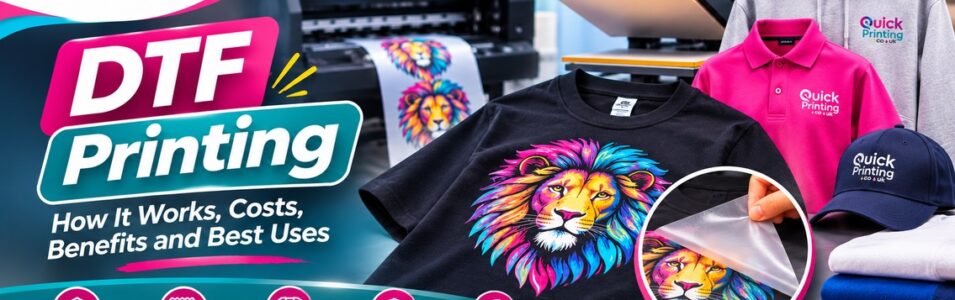
DTF Printing in London: How It Works, What It Costs and When It’s the Right Choice
You’ve got a design ready. Maybe it’s a multi-colour logo for your team, an illustration you’d love to see on a hoodie, or a favourite photo you want on a one-off gift. Then you start looking at printing methods and run straight into a wall of jargon: DTF, DTG, vinyl, screen printing. Every company claims theirs is the best, and hardly anyone explains what that actually means for your order, your budget and your deadline.
This guide covers DTF (Direct to Film) properly. We’ll look at how the process works, what affects the price, which garments suit it, how to prepare your Design and, just as importantly, when DTF isn’t the right choice. If you’re searching for DTF printing in London, you should come away knowing exactly what to ask for and what to send us, so your order goes through smoothly the first time.
What Is DTF Printing?
DTF stands for Direct to Film. Your design is printed onto a special transfer film, coated with a fine adhesive powder, cured with heat and then pressed onto the garment. Once it’s been pressed, the design sits on the fabric as a thin, flexible layer, rather than soaking into the fibres.
That’s the key difference from DTG (direct to garment) printing, where the ink is applied straight onto the fabric. Because DTF starts life on a film, it isn’t as fussy about what you’re printing onto. Cotton, polyester and many blends are all possible, and detailed full-colour Design on dark garments is rarely a problem. You can print a single T-shirt or a few dozen, and there are no screens to prepare and no strict limit on how many colours your design can use.
That flexibility is why DTF has become such a popular choice for personalised clothing across the UK. It suits businesses, clubs, event organisers and individuals who want a sharp, colourful result without having to order hundreds of items.
How Does DTF Printing Work, Step by Step?
The finished T-shirt looks simple, but there are five stages behind it, and each one affects how good the print looks and how long it lasts. Understanding them also helps you see why a careful printer produces better results than a rushed one.
- Checking the Design. Before anything is printed, the design is checked for size, resolution and transparency. A sharp PNG with a transparent background, or a clean vector file, is ideal. A screenshot saved from social media is not, because enlarging a small image never adds detail that wasn’t there to begin with. This is why fine lettering and thin lines are usually the first things to look soft when the Design isn’t up to standard.
- Printing onto the film. The design is printed onto the transfer film using colour inks, followed by a layer of white ink. That white layer is what keeps the colours bright when the design is pressed onto black, navy or dark green garments. Without it, the colours would sink into the fabric and look dull.
- Applying the adhesive powder. While the ink is still wet, a fine heat-activated powder is spread over the film. This powder is the bond between the print and the fabric, so an even coating matters. Too little and the design may not stick properly, while too much can leave a rough residue around the edges.
- Curing the transfer. The film is then heated so the powder melts and sets. This step needs to be controlled carefully. If the transfer is under-cured, it may peel after washing, and if it’s over-cured it can become stiff or brittle.
- Heat pressing onto the garment. Finally, the transfer is positioned on the T-shirt, hoodie or other item and pressed using the correct temperature, pressure and time for that particular fabric. The film is peeled away, leaving the design on the garment. Most of the “my print cracked after a couple of washes” stories we hear trace back to a rushed cure or the wrong press settings, not to DTF itself.
Why Choose DTF Printing? The Real Benefits
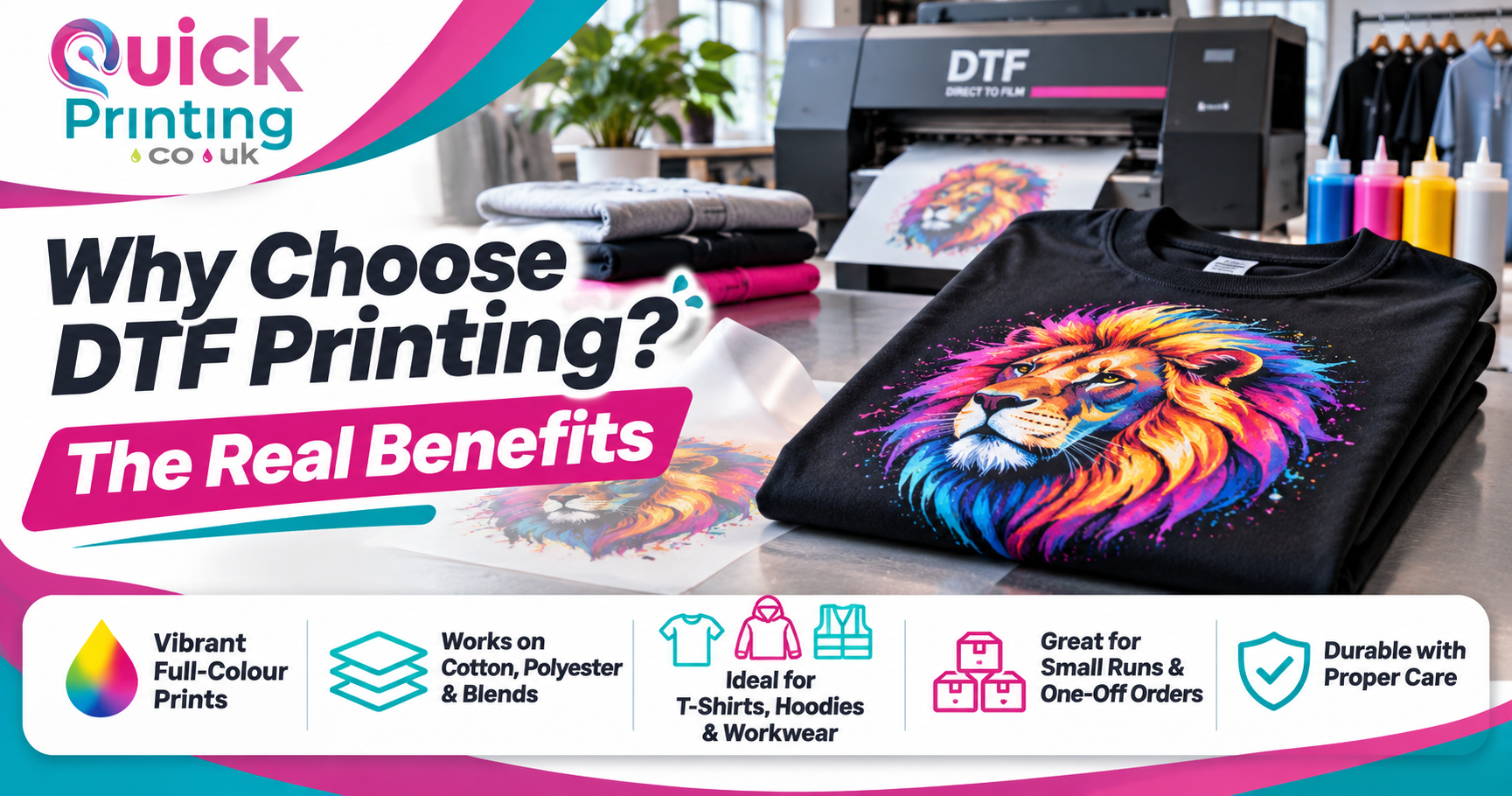
DTF isn’t the answer to every job, but it solves several problems that come up again and again with custom clothing.
The first is full colour without extra setup. A logo with five colours, a soft gradient and fine lettering can be printed in a single pass. With traditional screen printing, every colour needs its own screen, which pushes the price up on small orders and makes complicated Design impractical.
The second is flexibility across fabrics. If your team wears a mixture of T-shirts, sweatshirts and workwear, DTF makes it much easier to get the same logo looking consistent on all of them. It’s worth saying that fabric suitability still needs checking, particularly with waterproof coatings or heat-sensitive materials.
Then there’s suitability for small runs. You might want five tops for a stag weekend, twelve hoodies for a university society, or one personalised sweatshirt for a birthday. Because DTF doesn’t need a separate physical screen for each colour, it makes sense at those quantities, which is where many other methods become expensive per item.
DTF also gives you consistent branding. Once your Design is set up properly, the same design can go onto different garments at the same size and in the same colours. For a business, that consistency matters more than people expect. Finally, it copes well with dark garments, thanks to that white underbase, so you aren’t limited to white or pale T-shirts.
Which Garments Can You DTF Print?
The garment you choose changes how the finished print looks and feels, so it’s worth deciding on purpose rather than just picking the cheapest option.
T-shirts are the classic choice, and smooth cotton gives a good surface for detailed designs. At Quick Printing in London, T-shirt printing starts from £6.99 on Gildan 100% cotton ring-spun shirts, with no minimum order. If your staff will be wearing them every week, it’s worth asking about heavier alternatives, because a thin shirt that suits a one-day event may not last as everyday workwear. You can see the options on our custom T-shirt printing page.
Hoodies and sweatshirts are popular for leavers’ hoodies, clubs, societies and staff uniforms. DTF reproduces detailed Design well on the front or back, but a very large solid print can feel stiffer than a small chest logo. If comfort matters, keep the design to a sensible size. If you’re planning a group order, take a look at our custom hoodie printing range.
Workwear is another good fit. Company logos on T-shirts, sweatshirts and polos are straightforward, and they help customers recognise your team at a glance. For hi-vis vests and jackets or specialist fabrics, the method and placement need checking first, so tell us what the garment will be used for.
Polyester is possible, but it needs more care. Excessive heat can damage some fabrics, and certain dyed polyester garments can bleed colour into the print. A good printer chooses settings to suit the fabric rather than pressing everything the same way.
You can also bring your own garments. If it’s something delicate or unusual, just let us know beforehand so we can check it’s safe to press. And if you’re still deciding what to print on, our guide on how to choose the right T-shirt for printing covers fabric, fit and colour in more detail.
DTF vs Other Printing Methods: A Quick Reality Check
There’s no single best method, only the best one for your particular order. DTF suits detailed, multi-colour Design, mixed fabrics and small to medium runs. DTG is often chosen for detailed Design on cotton where a softer feel is the priority. Heat transfer vinyl is ideal for names, numbers and simple one-colour designs, and it’s the reason instant football shirt lettering is possible. Screen printing tends to be the most cost-effective for large runs of the same design with only a few colours, while embroidery gives polos and caps a textured, premium finish.
We offer all of these at Quick Printing, which means our recommendation isn’t tied to whichever machine happens to be free. If you’d like the full side-by-side breakdown, our comparison of DTF vs DTG vs vinyl goes into much more detail.
As a simple rule of thumb, if your design has lots of colours and you need fewer than fifty pieces, DTF is usually worth a serious look. If you need hundreds of identical one-colour shirts, it’s worth asking about screen printing before you commit.
How Much Does DTF Printing Cost in London?
Nobody can give you one price that applies to every job, and anyone who does is probably guessing. What matters is understanding what actually moves the price, so you can compare quotes properly.
Print size is the first factor. A small left-chest logo uses far less material than an A3 design across the back, and the price reflects that. The number of print positions matters too, because front-only printing costs less than front, back and sleeve, which involves extra materials, positioning and pressing.
The garment itself makes a big difference. A budget cotton tee and a heavyweight hoodie are very different starting points, so when you’re comparing quotes, check whether the garment is included in the price. Quantity also plays a part. Larger orders of the same design generally bring the cost per item down, although twenty identical staff shirts are much simpler than twenty shirts with twenty different designs.
Your Design can change the total as well. A print-ready file is quick to process, but if we need to rebuild a logo, clean up an image or resize a design, design time may be added. Lastly, your deadline matters. Urgent work takes priority in the production queue, so it’s best to mention your date when you ask for a quote rather than assuming every method is available for immediate collection.
For reference, T-shirt printing at Quick Printing starts from £6.99, with no minimum order. For a firm figure on DTF, send us the garment type, quantity, print size, number of print positions and your deadline through our quote page. We’ll tell you what it costs and whether DTF is genuinely the right choice for the job. Students and local charities can also ask about discounts.
How Long Does a DTF Print Last?
A well-made DTF print will cope with regular wear and washing, but how long it actually lasts depends on the quality of the transfer, the fabric, how carefully it was pressed and how you look after the garment afterwards. We’d rather not quote a magic number of washes, because it varies from one garment to the next, and any figure given without testing the specific item is really just a guess.
What you can control is aftercare, and it makes a real difference. Turn the garment inside out before washing, use a gentle cycle and follow the care label. Avoid ironing directly over the printed area, go easy on high-heat tumble drying, and try not to pick at or stretch the print, especially while it’s still warm from the dryer. Treat a printed hoodie the way you’d treat any garment you want to keep looking good, and it will repay you.
How to Prepare Design for DTF Printing
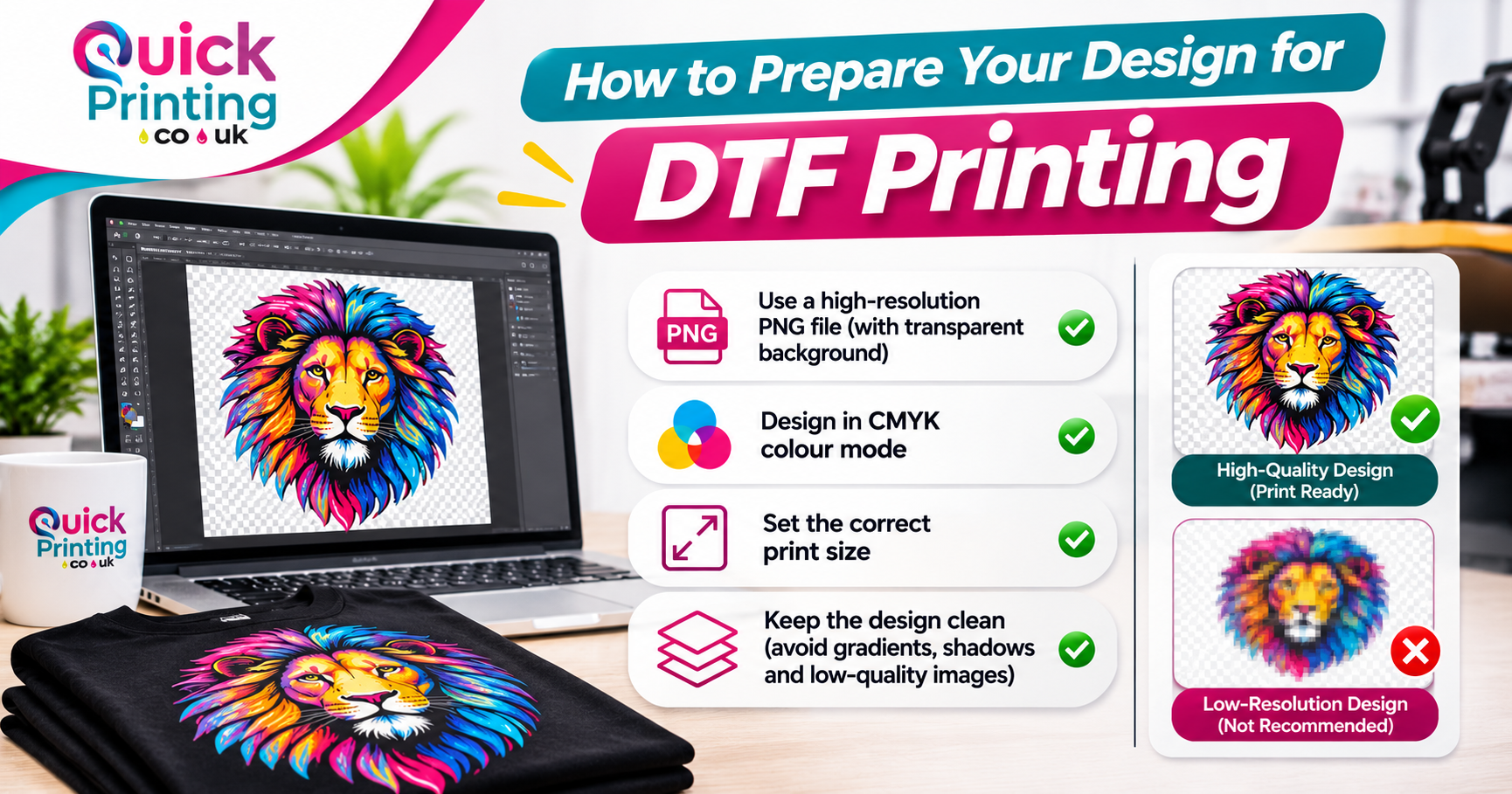
Poor Design is the single biggest reason prints disappoint. Your logo might look perfectly sharp on your phone, but a small file stretched across the back of a hoodie will come out soft and blurry. It’s one of the most common problems we see, and one of the easiest to avoid.
For full-colour designs, a high-resolution PNG with a transparent background is usually the best starting point, while vector files such as PDF, SVG or AI are particularly good for logos and text. Try to prepare the design at the size you actually want it printed, because enlarging a small image later doesn’t add detail. Watch out for white boxes around your design, too. If the background isn’t properly transparent, it can print as a solid block behind your Design.
Very thin lines, tiny text and faint shadows can also be lost on fabric, especially on textured garments, so it’s worth checking them before production. And simply converting a low-quality JPEG into a PDF won’t improve it. If you’re unsure, our Design guide explains the file types we prefer, and you can upload your design so we can check it before anything goes to print. If you don’t have a design yet, our team can create one, or you can start from a template. Our walkthrough on how to design your own custom T-shirt is a good place to begin.
Common DTF Mistakes (and How to Avoid Them)
The same issues come up again and again, and nearly all of them are avoidable. The most common is ordering before checking the file. A quick Design check at the start saves an awkward conversation about reprints later. Another is choosing the cheapest shirt for a long-term uniform. A thin tee is fine for a one-day event, but if your team wears it every week, spending a little more on the garment pays off.
Oversized prints on small garments are a regular problem, too. A huge solid block on a child’s T-shirt is neither comfortable nor flattering. Placement is easy to overlook, but where the design sits changes how professional it looks, and our guide to T-shirt print locations shows where logos usually work best. Finally, leaving the deadline until the last minute limits your options. If you need something for a specific date, say so at the start and we’ll tell you honestly what’s possible.
DTF Printing for London Businesses, Teams and Events
Different customers need different things, and the right setup changes depending on who’s wearing the clothing and why.
For cafés, salons and shops, matching T-shirts or hoodies help customers spot your team straight away and make a small business look more established. Before choosing a set, it’s worth reading our thoughts on why every business needs branded workwear. Tradespeople can pair branded tops and jackets with van signage, so the whole business looks consistent before you’ve said a word.
Sports teams and football fans often have two needs at once. Detailed crests may suit DTF, while names and numbers are often better done in vinyl, so take a look at our football shirt printing options. Schools, colleges and societies are a natural fit for DTF, particularly for leavers’ hoodies and society tops, and we have dedicated offers for schools and colleges and gyms and sports clubs.
Parties and events usually mean small batches with fun, colourful designs, which is exactly where DTF earns its place. Our list of T-shirt ideas for birthdays, hen parties and stag dos might save you some brainstorming.
Where to Get DTF Printing in South East London
Our Charlton branch is at 238 Woolwich Road, London SE7 7QU, an easy stop if you’re in Greenwich, Woolwich, Kidbrooke, Eltham, Deptford, Lewisham or around the Greenwich Peninsula. You can drop in with your Design and garments, talk through the options face to face and leave with a clear idea of cost and timing, which is far easier than going back and forth over email.
If you’re on the Kent side, our Dartford branch is at 60 Spital Street, DA1 2DT, and the details are on our Dartford page. If you’re elsewhere in the capital, have a look at our Print in London service, and for the Charlton branch specifically, see our Charlton page.
Can’t visit? You can upload your design online. We offer free UK delivery and next-day nationwide delivery, and you can check the details on our delivery page. We’re open Monday to Saturday, 9 AM to 6 PM, and closed on Sundays.
DTF Printing FAQs
Is DTF printing good for T-shirts?
Yes, it’s one of the most practical methods for T-shirts, especially when the design has more than a couple of colours. DTF works on many cotton, polyester and blended tees, and it reproduces fine lettering, gradients and detailed illustrations well. It’s also a sensible choice for small orders, because there are no screens to set up for each colour. That said, it isn’t automatically the best method for every job. If you need several hundred identical one-colour shirts, screen printing may work out better value, so it’s worth telling us your quantity before you decide.
Is DTF printing better than vinyl?
It depends on what you’re printing. DTF is usually the better choice for full-colour or detailed Design, such as a multi-colour logo, an illustration or a photo-style design. Heat transfer vinyl is often better for simple lettering, names, numbers and single-colour graphics, which is why it’s so popular for football shirts and team kits. Many customers actually use both on the same order, for example a detailed crest in DTF and player names in vinyl. If you’re not sure which suits your design, our comparison of DTF vs DTG vs vinyl walks through the differences in more detail.
Can you DTF print on black T-shirts?
Yes. This is one of DTF’s biggest strengths. A layer of white ink is printed beneath the colours, so the design stays bright and clear on black, navy, dark green and other dark garments. Without that white base, colours would sink into the fabric and look dull. The result depends on the Design too, so very fine details and faint shadows should be checked before printing. If you’re ordering dark garments for a team or event, send us your design first and we’ll let you know if anything needs adjusting.
Can I order just one DTF-printed T-shirt?
You can. Quick Printing has no minimum order on T-shirt printing, with prices starting from £6.99 on Gildan 100% cotton ring-spun shirts. That makes a single personalised tee perfectly realistic, whether it’s a birthday gift, a one-off design or a sample before you place a bigger order. Keep in mind that the final price depends on the garment, the print size and the number of print positions. For a firm figure, send the details through our quote page or pop into the Charlton branch.
Does DTF printing feel thick?
DTF forms a thin, flexible layer on top of the fabric, so it can feel slightly different from a print that soaks into the fibres. Small and medium designs, like a chest logo, usually feel light and comfortable. Large solid areas, such as a full back print, are more noticeable, particularly on thinner garments. The feel also depends on the garment, the size of the Design and how much of the design is covered in solid colour. If comfort matters, for example on kids’ clothing or everyday uniforms, keep the design a sensible size or ask us about the best placement.
What file is best for DTF printing?
For full-colour Designk, a high-resolution PNG with a transparent background is usually a good starting point. For logos and text, vector files such as PDF, SVG or AI are ideal because they stay sharp at any size. Whatever you use, prepare the file at the size you actually want it printed, because stretching a small image makes it look soft and blurry. Watch out for white boxes behind the design, as they can print as a solid block if the background isn’t properly transparent. Our Design guide explains this in more detail, and we’re happy to check your file before production.F
Can I bring my own clothes to be printed?
Yes, you can bring your own garments. It helps to tell us the fabric and how the item is made, because some materials, such as delicate fabrics, waterproof coatings or heat-sensitive items, can be damaged by pressing. If we think a garment isn’t suitable, we’ll say so honestly before we start rather than risk spoiling it. If you’d rather choose from our range instead, take a look at our custom T-shirt printing page.
Can DTF printing be used for business uniforms and workwear?
Yes. DTF is well suited to company logos on T-shirts, sweatshirts, hoodies and many polos, particularly when the logo has several colours. It also helps keep your branding consistent across different garments. For specialist items such as hi-vis vests and jackets, the method and placement need to be checked first, so tell us what the garment will be used for. If you’re building a full uniform set, our guide on why every business needs branded workwear is worth a read before you order.
How do I wash and care for a DTF-printed garment?
Turn the garment inside out before washing, use a gentle cycle and follow the care label. Avoid ironing directly over the print, and go easy on high-heat tumble drying, since too much heat can affect the transfer over time. It also helps not to pick at or stretch the printed area, especially when it’s warm. Good aftercare makes a real difference to how long a print looks fresh, although exact durability depends on the garment, the fabric and how it was pressed.
How do I get a DTF printing quote in London?
Send us your garment type, quantity, print size, number of print positions and deadline through our quote form. If you’d rather talk it through, you can visit the Charlton London branch at 238 Woolwich Road, London SE7 7QU, or call +44 20 8464 6464. We’re open Monday to Saturday, 9 AM to 6 PM. If you have general questions first, our FAQ page covers the basics. Having your Design ready means we can give you a quicker and more accurate answer.
Ready to Print Your Design?
Start with the design and the garments you have in mind. Then work out your quantity, where you’d like the print to sit and when you need it by. With those four things, you’re already most of the way to an accurate quote.
Bring that to us at Quick Printing, whether you walk in at Charlton London or send your Design online, and we’ll tell you honestly whether DTF is the right method or whether something else would suit the job better.
Call the Charlton London branch on +44 20 8464 6464, email info@quickprinting.co.uk, or request a quote today.